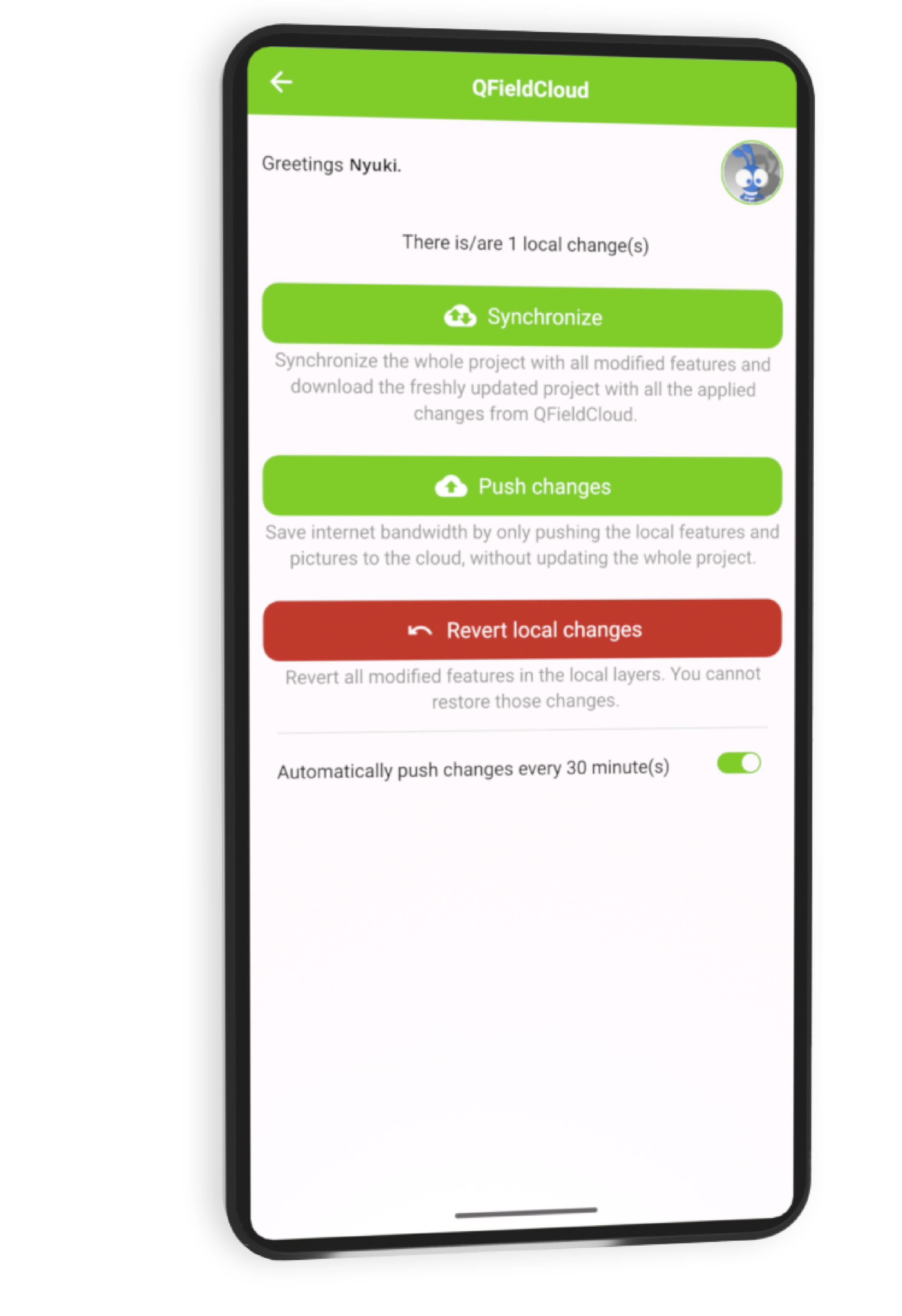
Synchronise
and collaborate.
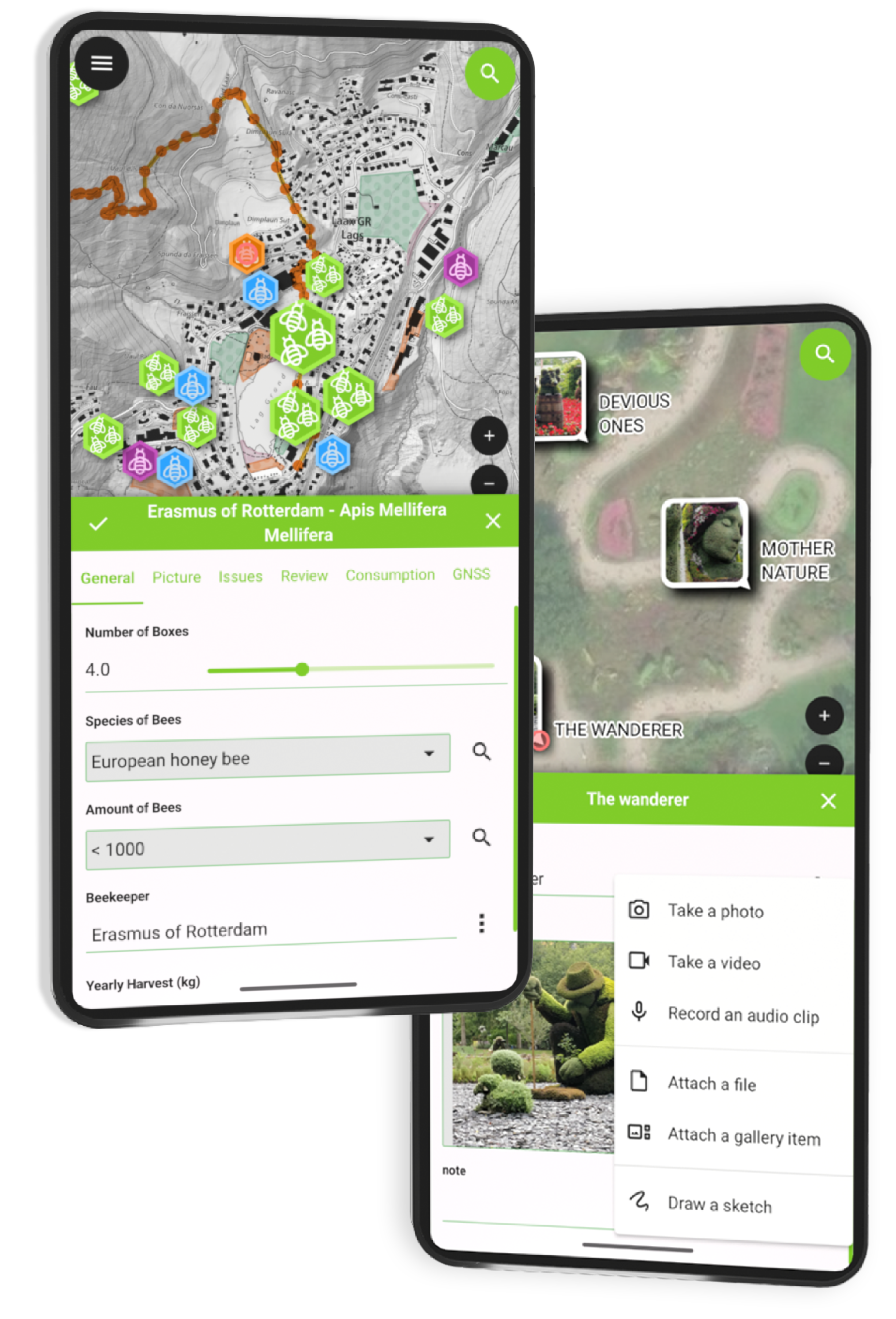
Collect
and edit data.
QFieldCloud allows to synchronize and merge the data collected by your team in QField. From small individual projects to large data collection campaigns, QFieldCloud removes the pain from synchronizing and merging data.

Sync projects and data in real time and work with GeoPackages, KML, GPX, georeferenced PDFs, and more.

Create rich survey forms with constraints, logic, defaults, and validations — all in QGIS.

Working in the wild ? You can continue to work seamlessly with QFieldCloud, and sync back your changes once you're back in town.

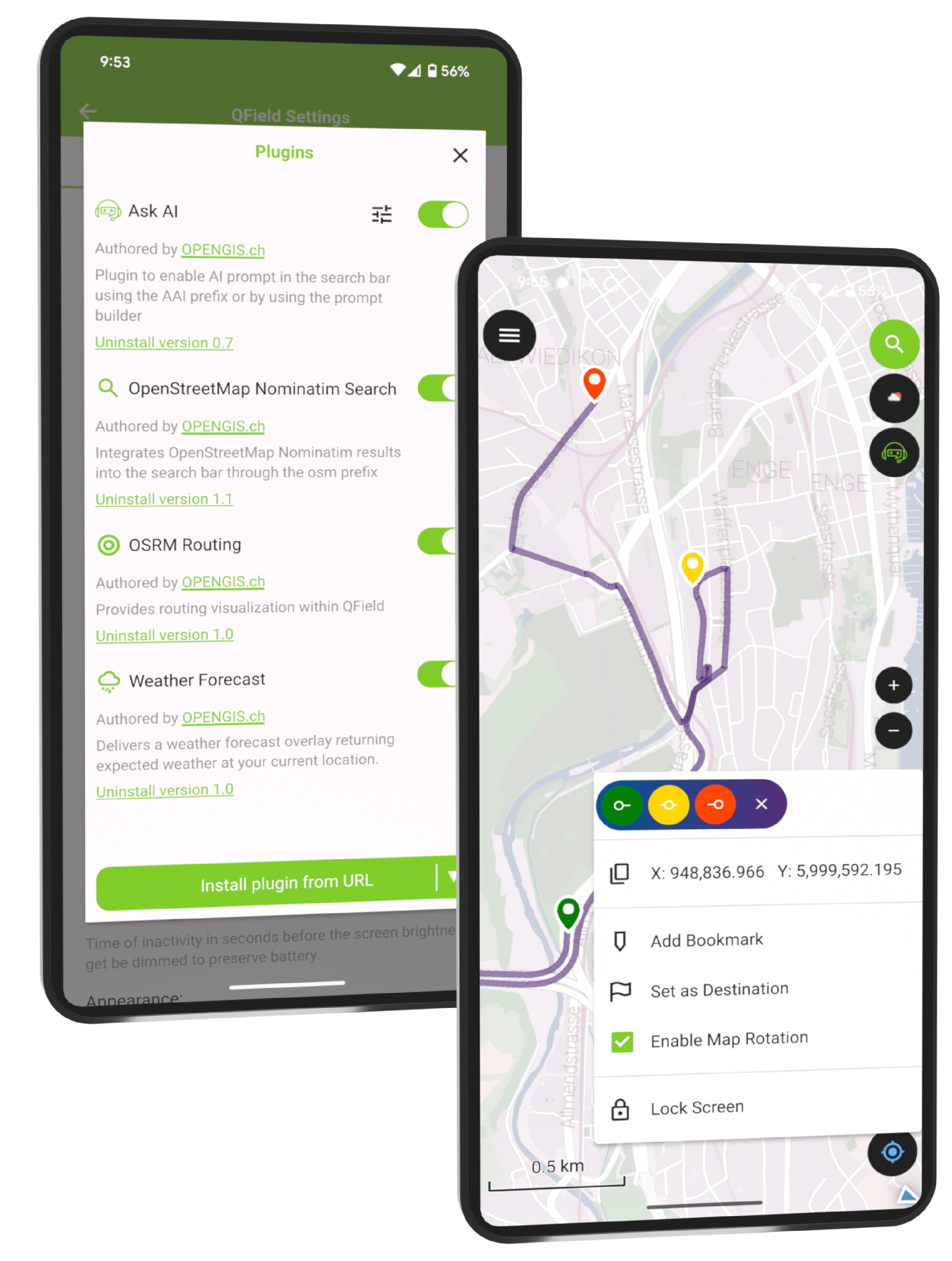
QFieldCloud perfectly integrates and extends your QGIS based geodata infrastructure.

Subscribe for a worry-free Swiss-made solution hosted on Swiss datacenters or contact us for your private cloud instance.

QFieldCloud code is open source so you can see what is actually happening to your data.
Let QFieldCoud manage it. Accurately, efficiently, and anywhere it matters. Get started now
While "pppe-153 Mosaic01-58-38 Min" may never be a household name, it represents the backbone of modern technical documentation. Whether it’s mapping the stars, building the next generation of smartphones, or archiving the world's digital history, these alphanumeric strings ensure that nothing gets lost in the shuffle.
: This is likely an abbreviation for "Minimum," "Minute," or "Minor." In the context of data logs, it often represents the minimum threshold detected during a specific scan or the minute-marker of a recording. Applications in Modern Industry
: These are almost certainly coordinates or time-stamps. In celestial mapping, this would indicate declination and right ascension. In manufacturing, it might refer to the X and Y coordinates on a silicon wafer or a specific grid on a PCB. pppe-153 Mosaic01-58-38 Min
While the string might look like a random jumble of characters to the uninitiated, it actually follows a specific nomenclature often found in specialized digital archiving, astronomical data sets, or technical manufacturing logs.
When telescopes like the James Webb or Hubble take photos, they don’t just take one "picture." They take hundreds of small tiles that are stitched together. A code like Mosaic01-58-38 would tell a researcher exactly which "tile" of the sky they are looking at within the larger pppe-153 project. 2. Semiconductor Manufacturing While "pppe-153 Mosaic01-58-38 Min" may never be a
To understand what "pppe-153 Mosaic01-58-38 Min" refers to, we have to look at its constituent parts. This is a classic example of .
: This is typically a project or batch prefix. In engineering or data science, "PPPE" often stands for a specific protocol (like a Pre-Processing Production Environment) or a specific hardware part series. The number "153" identifies the specific iteration or batch within that series. Applications in Modern Industry : These are almost
: A "mosaic" in technical terms usually refers to a composite. In imaging, it’s a large image made of smaller tiles. In biology, it can refer to genetic sequencing from different cells. The "01" suggests this is the primary or first set of the composite.
In the world of microchips, "Mosaic" patterns are used to test the uniformity of wafers. If a defect is found at the 58-38 coordinate, engineers can trace it back to the specific batch ( pppe-153 ) to see if the entire production line is compromised. 3. Digital Forensics and Archiving



QField and QFieldCloud form the leading professional fieldwork platform used in enterprise settings for efficient geospatial data collection, synchronization, and management. As Digital Public Goods, they not only excel in enterprise and professional applications but also contribute significantly to advancing at least six of the United Nations Sustainable Development Goals (SDGs), promoting a more sustainable and equitable future.
Subscribe to our newsletter and stay up to date on the latest and greatest!
QField is released under the GNU Public License (GPL) Version 2 or above. QFieldCloud is released under the MIT License. Developing our solutions under these licenses means that you can inspect and modify the source code and guarantees that you will always have access to a complete QGIS-based field data collection and synchronization platform that is free of cost and can be freely modified.
View our Legal Information to learn about our privacy policy, terms of service, data processing agreement (DPA), and other legal matters.
QField, QFieldCloud and QFieldSync are developped by OPENGIS.ch. OPENGIS.ch offers consulting, development, training and support for open-source software including QField, QGIS and PostGIS.