Peter's electronic projects Peter's electronic projects
: Investigating how word properties influence sentence construction.
Unlike many theoretical texts that rely heavily on the history of linguistics, Radford focuses on available at the time, specifically drawing from Noam Chomsky’s Knowledge of Language and Barriers . This ensures that readers are learning models relevant to modern syntactic research rather than abandoned historical concepts.
For those seeking digital access, versions of this textbook are available through various platforms:
: Exploring grammatical competence and the mental processes behind language production.
: Detailed analysis of how sentences are formed using word-level and phrasal categories.
by Andrew Radford remains one of the most influential and pedagogically sound introductions to syntactic theory since its first publication in 1988. Designed for students with little to no background in syntax, this comprehensive textbook provides a bridge between traditional grammar and contemporary work in Transformational Generative Grammar (TGG) . Core Objectives and Scope
: Known for his "trademark approach," Radford sequences chapters so they increase in difficulty, moving from elementary structure to complex operations like WH-movement and Alpha-movement .
Radford's work is celebrated for its ability to demystify complex linguistic concepts through a step-by-step approach. The book primarily focuses on four key areas of linguistic inquiry:
: Each chapter ends with a variety of exercises designed to let students apply theoretical concepts to real-world sentence analysis.
: Explaining the rules that derive "surface structures" (actual sentences) from more abstract "deep structures". Why Choose Radford's First Course?
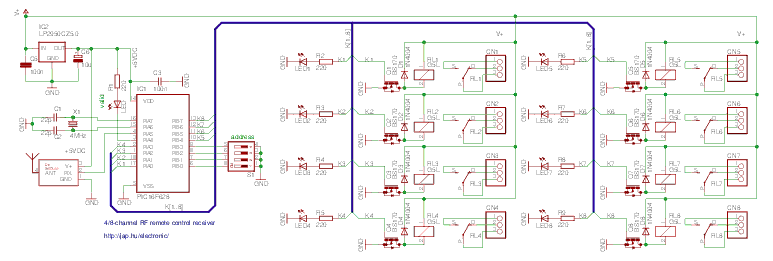
 Try it now, before building! Click on the transmitter buttons with the
green
labels
on the left and see how the receiver outputs (K1-K8) change. Change
the number of transmitter or receiver channels. Switch the receiver
output type between latched and momentary.
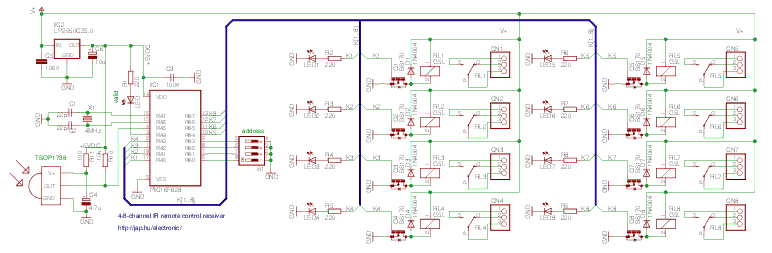
Try it now, before building! Click on the transmitter buttons with the
green
labels
on the left and see how the receiver outputs (K1-K8) change. Change
the number of transmitter or receiver channels. Switch the receiver
output type between latched and momentary.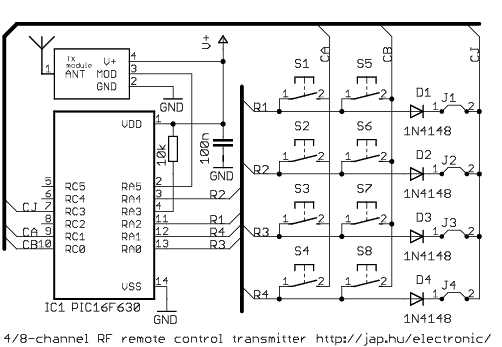
| part | description |
| C1 |
100nF ceramic capacitor |
| R1 |
10k resistor (1/8W) |
| D1-D4 | 1N4148 diode (optional) |
| S1-S8 |
tact switch, DTSM 61N or similar |
| IC1 | PIC16F630 or PIC16F676 microcontroller, pre-programmed |
| TXMOD |
radio
transmitter module, see text (hardware) |
| B1 |
battery between 2-5.5VDC (check TXMOD specs for valid voltage range) |
| part | description |
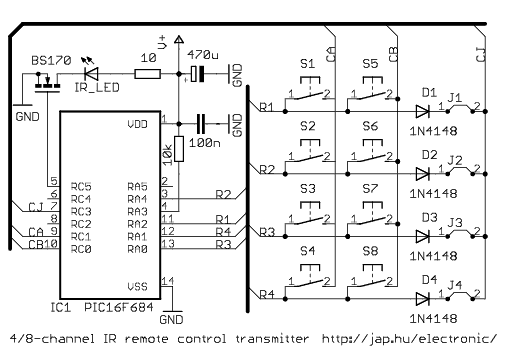
| C1 |
100nF ceramic capacitor |
| C2 |
470 uF 6.3V, electrolytic
capacitor |
| R1 |
10k resistor (1/8W) |
| R2 |
10 ohm resistor (1/4W) |
| D1-D4 | 1N4148 diode (optional) |
| D5 |
IR transmitter LED |
| Q1 |
BSS138 or similar N-MOSFET |
| S1-S8 |
tact switch, DTSM 61N or similar |
| IC1 | PIC16F684 microcontroller, pre-programmed |
| B1 |
battery between 2-5.5VDC (CR2032, 3.6V LiIon battery or 3xAA
batteries) |
| please
observe the corresponding address configuration! |
|
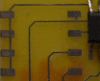 transmitter: no diodes connected |
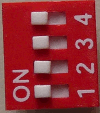 receiver: switches all ON |
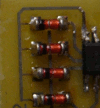 transmitter: all diodes connected |
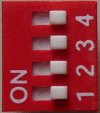 receiver: switches all OFF |
parts list
| part | description |
| C1, C2 | 22pF ceramic capacitor |
| C3, C5 | 100nF ceramic capacitor |
| C6 | 10uF 6.3V electrolytic capacitor |
| CN1-CN8 | PCB terminal block, 3-way (DG301) |
| D1-D8 | 1N4004 diode |
| IC1 | PIC16F627 or PIC16F628 or PIC16F627A or PIC16F628A microcontroller, pre-programmed |
| IC2 | LP2950CZ5.0 voltage regulator |
| LED | 3mm LED (green) |
| LED1-LED8 | 3mm LED (red) |
| Q1-Q8 | BS170 N-channel mosfet transistor |
| R1-R9 | 220R resistor (1/8W) |
| RL1-RL8 | G5LE relay, see text for coil voltage selection |
| S1 | piano DIP switch, 4-way |
| X1 | 4MHz HC49 crystal |
| RXMOD | 3-pin radio receiver module, see text (hardware) |
| please
observe the corresponding address configuration! |
|
| transmitter: no diodes connected |
receiver: switches all ON |
| transmitter: all diodes connected |
receiver: switches all OFF |
: Investigating how word properties influence sentence construction.
Unlike many theoretical texts that rely heavily on the history of linguistics, Radford focuses on available at the time, specifically drawing from Noam Chomsky’s Knowledge of Language and Barriers . This ensures that readers are learning models relevant to modern syntactic research rather than abandoned historical concepts.
For those seeking digital access, versions of this textbook are available through various platforms:
: Exploring grammatical competence and the mental processes behind language production.
: Detailed analysis of how sentences are formed using word-level and phrasal categories.
by Andrew Radford remains one of the most influential and pedagogically sound introductions to syntactic theory since its first publication in 1988. Designed for students with little to no background in syntax, this comprehensive textbook provides a bridge between traditional grammar and contemporary work in Transformational Generative Grammar (TGG) . Core Objectives and Scope
: Known for his "trademark approach," Radford sequences chapters so they increase in difficulty, moving from elementary structure to complex operations like WH-movement and Alpha-movement .
Radford's work is celebrated for its ability to demystify complex linguistic concepts through a step-by-step approach. The book primarily focuses on four key areas of linguistic inquiry:
: Each chapter ends with a variety of exercises designed to let students apply theoretical concepts to real-world sentence analysis.
: Explaining the rules that derive "surface structures" (actual sentences) from more abstract "deep structures". Why Choose Radford's First Course?
LATCH_MASK EQU B'00001111' sets channels 8-5 to momentary
and
channels 4-1 to latched (toggle) mode. Then use the compiler (MPLAB or
gputils) to
assemble the code.clrf
0x91 ;
ANSEL